If you’re willing to go black hat, it’s easy enough to boost your app’s reviews in the App Store through astroturfing. The downside, however, is not just that it’s unethical – it’s also forbidden by Apple and will probably get you booted out of the App Store. This level of risk is a big turn-off for many would-be black hatters, but what if I told you that there’s a way to manipulate your real users into leaving substantially more positive reviews, and for some reason Apple are turning a blind eye to it?
To get a good understanding of the whole story about manipulating App Store reviews, we need to start by looking back to 2008, when Apple introduced the rate-on-delete dialog.
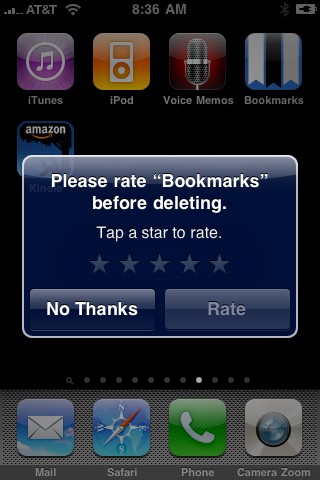
image source: buildingreputation.com
You can see what they were trying to do here. When deleting an app, a user is guaranteed to have had an experience with it – but the fact is people never delete apps when they’re happy with them, so ratings became negatively skewed. Developers were angry and Apple eventually ditched the rate-on-delete dialog. As a case study this tells us a clear lesson. If you can find a subtle way to segment your users by their sentiment towards your app, you can then ask one of those segments to write reviews and not the other, thus skewing the ratings.
Back in 2009 when Apple’s rate-on-delete dialog was still in full force, a guy called Arash Payan created Appirater, a simple class that you can drop into any iPhone app and it simply reminds users to leave reviews after a certain period of time and/or number of uses.
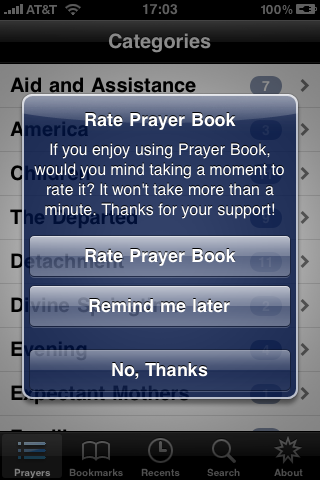
Image source: arashpayan.com
I’d describe Appirater as using an honest, white-hat approach. It asks the user to leave a review without trying to first trying to segment them by sentiment. Now let’s take a look at Occipital’s 360 Panorama app.
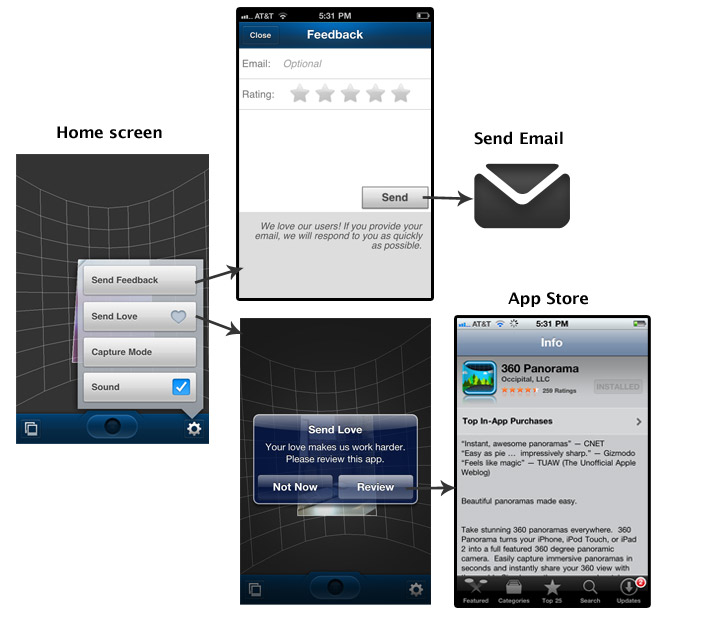
Image source: Mobileorchard.com
In 360 Panorama, Occipital use some clever microcopy in their settings menu, as shown above. The first option is “Send Feedback” which fires off an email to the developers. The second is “Send Love” which takes the user to the App Store review interface. It really all boils down to that label. The words “Send Love” subtly funnel users with a positive sentiment towards leaving an App Store review. After all, why would someone with a negative sentiment tap that menu item? They’d be far more likely to tap “Send Feedback” and vent through the conveniently private medium of email. All things considered, this interface is a little manipulative – darker grey than Appirater for sure.
Now let’s take a look at Appsfire. In this blog post they proudly announced that they’d “found a great way to improve the rating of your app in the App Store. It’s legal and by the book.” Well, let’s take a look and make our own minds up:
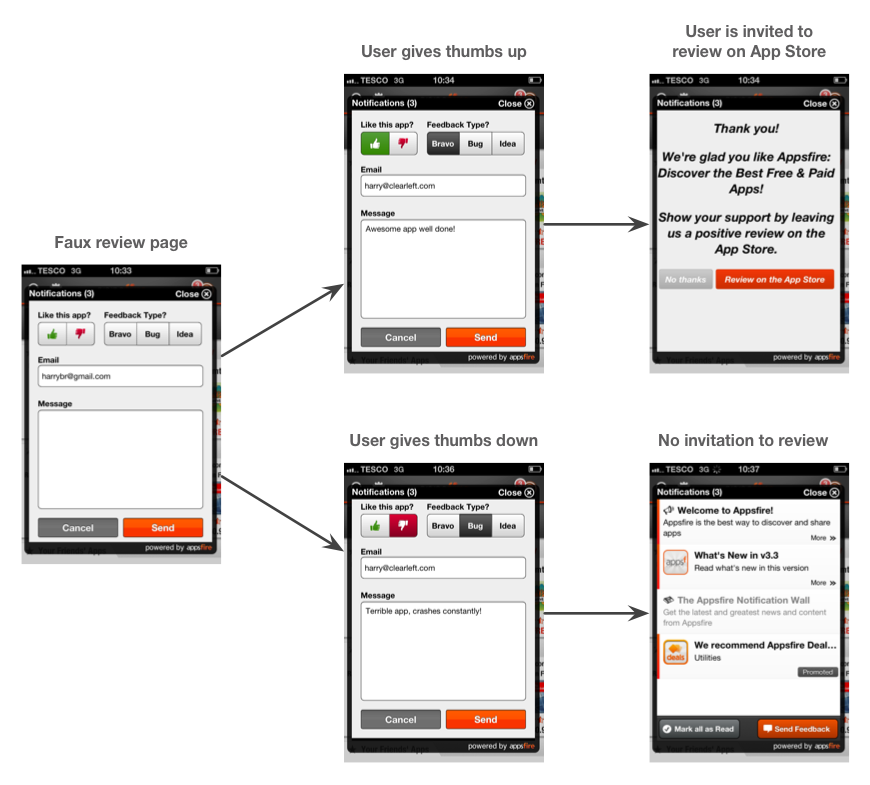
Appsfire’s Appbooster tool has its own non-App Store review UI (far left) which the user can reach through their notifications panel. If the user taps the green thumbs up icon and submits the form, they are invited to leave an App Store review. If they tap the red thumbs down icon, what happens? Nothing. They are given no easy way to post-up their negative review. If they realise their review has not actually been submitted to Apple, and if they’re feeling highly motivated, they could leave the app, open the App Store, enter a search query, find the correct app, scroll down to the bottom of the page, tap on the ratings and then finally they can tap “write a review”. But how many people are going to bother doing that?
Is this a Dark Pattern? It certainly fits the definition. It’s frustrating that Apple rejects apps for the most trivial reasons, but lets this sort of thing through. What do you think?
Edit 21-May-2012: join the discussion on Hacker News
Hi there. This is ouriel co-founder of appsfire.com
For the record we re an app recommendation and marketing company. We are an app developer ourselves and works with hundreds of developers out there.
i wanted to follow up on your note regarding app booster.
First off App booster is not a review system. It is a simple a dialog system between the developer and the user. It includes a among other elements a simple feedback system which is not a review UI. It is a way for users to simply and directly contact the developers. Like thousands of apps we had at the beginning a simple email feedback system, but we realized that all it was creating was poor quality feedback – mostly blank emails. Many developers were in the same situation. So we decided to create our own app specific, mobile feedback system.
The idea behind this feedback system was, unlike the app store, to allow the developer to have a chance to respond before the user posts a bad review. Many times bad reviews are published for the wrong reasons and are wrongly attributed to the developer who has no chance to answer in the app store (eg users complaining of an app performing poorly, when the problem was the wifi connection or poor 3G connection..). We had to create a system that allow the developer to have a chance to answer first. If we were suggesting the user to drop a negative review in the app store, then we would simply kill that possibility.
When a positive feedback is sent, it is mostly likely one that does not need an answer and it felt right to entice the user to visit the app store to publish a review there. Note that unlike other methods you are describing in your post this is not forced to all users by a popup, It is natively integrated in the flow of a user already satisfied in the app. Jumping from there to the app store is not incentivized or rewarded in anyway (your post does not mention those methods used by many apps who will ask for a like on Facebook or pay users to review apps which are clearly manipulative methods). The review comes in context in a full optin way, with no tricks.
When using App booster, Users know they are not submitting a review to the App store and they send “Feedback” to the developer because this is the app messaging system. I am not sure why you would consider it differently and i would suggest an edit to your post. You seem to indicate we may try to confuse user with that approach?
We don’t agree with your interpretation this is manipulation. As a matter of fact we believe this is the right thing to do. It just makes things right for the developer and the user. No one is forcing any one and a real dialog can take place – no tricks of anyway. The real problem is that the review system is broken in the app store. It is being gamed, it is being manipulated, but you should look in a different direction: look at services paying or rewarding users creating massive pattern of ratings in a matter of hours.
For the record we created for our quality index (App score) a system that detects abnormal rating patterns. We know a little about that. http://blog.appsfire.com/introducing-the-appsfire-app-score-the-ultimate-quality-score-for-mobile-apps/
App booster is an user friendly, developer friendly way to re-establish what the app store has never offered: a direct dialog channel with the user and a smart feedback system to treat efficiently bad and good feedback.
Let me know if you have more questions
PS: We actually showed our system to some people at Apple who actually reacted very positively to the initiative.
Well, I have to admit that in the discussion on Hacker News not everyone agreed with me, so this is definitely a grey area – in fact I think this is what makes it so interesting.
For the sake of continuity, I’ll paraphrase my HN comment here:
It’s true that Apple’s App Store design encourages users to vent into reviews because it does not provide a straightforward way to contact the developers or raise a support ticket. This is bad and it really needs fixing.
However, your approach is not neutral. Just take a look at the diagram for a minute. After a user submits positive feedback, they are invited to leave a review. After a user submits negative feedback, they are not invited to do so – only a highly motivated user would then bother to leave the app, find the entry in the App Store and write a review there. What’s more, it’s hard to say whether some users will even understand the difference between your internal feedback UI and the Apple App Store review UI. i.e. they might think that your feedback form posts into the App Store reviews area.
Whether you think it’s ethical or not, you have to agree that the UI is somewhat manipulative.
Harry
your post thesis is that our practice is “evil” enough to be a case of rejection by Apple. And we simply state that this is an exaggerated statement and the balance brought by commenters in HN is supporting that.
There are Dark patterns that really exists and that your post ignore to mention. We have published a very extensive response to your article on our blog.
I invite you to take a look at it. In particular at the Diagram we completed and which brings a more detailed look at how the process works and why it is right to do what we do
You may not like it, but this is just the right thing
Excellent arguments on both sides!
Pingback: TechnoBuffalo | Immerse Yourself in Technology
After reading the post and answers, and based on my own experience as a user of apps, i consider the post has a valid question (not a sanction), appsfire has the best intention to protect the developer (understandibly) but it createas a bias in the process which would be easily solved by e.g. 1.- Stating clearly that reviews wont appear in appstore 2a.- offering the app store review button in both options, or 2b, offering the review button after a response from the developer or a max of e.g. 7 days.
Just sayin
Oh, and about “You may not like it, but this is just the right thing”, really? No chance of error in interpretation? Only one right way?
Hi Carlos,
I’m a Product Manager at Appsfire. We appreciate your feedback. I’d add a few things:
1) Transparency is very important to us (try out our app if you haven’t already and you’ll see), and we’ve discussed something like what you suggest. The argument against adding text like this is that people would be significantly less likely to send feedback if it had disclaimers/small print like “Your feedback will not appear in the App Store.” We’d then end up with much less of the valuable feedback that helps us a developer improve his app. That’s a negative outcome for users.
I would also add that we respond to every bit of feedback that we get, positive or negative. I can’t think of one occasion where users appeared to be confused about whether they were leaving a review in the App Store. Moreover, those who are unsatisfied with our answers to their feedback are free to leave negative reviews of us in the App Store. In fact those who have made the effort to send feedback and then read our response yet are still unsatisfied should be extra motivated to leave negative reviews!
2a) Say you were using standard alerts to prompt users to review your app in the App Store. If you had three opportunities to implement a “Please rate us” alert…
– After a user completed a positive action (e.g., favoriting something)
– After a negative action (e.g., submitting a crash report)
– After a completely neutral action (e.g., having just opened the app)
…in which one would you choose to display the “Review us” alert? Surely the first, no? Our feedback form logic is not that different — we’re asking users who are currently experiencing positive feelings about an app to support the app through positive reviews.
2b) I think I understand where you’re coming from — separating the moment of sending feedback from leaving the actual review. But consider that if anyone is under the false impression that they’ve actually just left a review, they’re going to learn that they didn’t actually leave a review when they get to the App Store and come across the blank review form. We don’t believe that even a small percentage of users is confused, therefore the time delay is a solution to a non-existent problem.
Feel free to engage with us on this here in this comment section or by email. My email ls jonathan AT appsfire DOT com
Good discussion, both sides make valid points. Nub of the matter is that app developers should have an opportunity to respond to brickbats and bouquets, and App Store does not afford developers such opportunity – probably because they don’t want the admin burden of moderating or mediating. But this is something they “owe” developers. Unless Apple offers this, I think Appsfire offers a legit approach, despite the bias it introduces.
of course the appfire developers have a lot to say here. I agree with Carlos, appfire made a way to protect developers, and from a user-centered point of view, it is manipulative and whether intentional or not, unethical. Let’s take a bit of this overly pedantic counter-argument appfire posted:
“Many times bad reviews are published for the wrong reasons and are wrongly attributed to the developer who has no chance to answer in the app store (eg users complaining of an app performing poorly, when the problem was the wifi connection or poor 3G connection..).”
So what you are saying is that users are wrong until proven correct? Or that developers should be able to prove that they are not at fault? I believe legitimate developers will take the good and bad with equal grace and stride, and not need such a shifty system to “protect” them. If a user is truly “wrong” and misuses an app, then it should be apparent that is the case and it won’t affect the overall rating. But this is a very developer-centric perspective. In reality, a well designed app has few or no ways to misuse it. It’s designed so that it communicates what it can and cannot do; users do not need to put in excessive effort to understand it.
But to the main point of this article and the ensuing argument, I have no doubt that the interface in the example here is manipulative and unethical. If the intention is truly to give a direct pipeline to the developers from the user, couldn’t the developer simply read the app store reviews and make the fixes for further updates? The facebook iOS app goes directly to the app store, no need for shifty re-directs. It also presents an image of honesty and integrity. And in the case that developers imagine users would actually want to have an extended conversation with the app developers for an app they dislike… (extremely unlikely), well in that case why would there not be an option to leave the review in the app store? Nobody is being fooled here, and the last argument of trying to create a dialogue is weak at best. Can you imagine using an app for 30 seconds, deciding you don’t like it, and then being asked to ensue in a long drawn out conversation with the developers about why you are wrong for not liking it? Let’s be real.
Hi L,
You make some excellent points, though I think your interpretation of earlier comments skews a little too far in the negative direction. Allow me to make the case for “bad reviews are published for the wrong reasons”…
As you mentioned, “A well designed app has few or no ways to misuse it. It’s designed so that it communicates what it can and cannot do; users do not need to put in excessive effort to understand it.” That’s true, and when users complain about, say, a particular function missing in our app, even though it’s actually there but the user can’t find it, then we take that feedback and discuss how we can improve it. If the user ends up leaving a negative review because of it, then we take our lumps. The user is not “wrong” in this scenario at all, he’s right.
But consider the example that was given: a poor network connection. Your average user (i.e., a non-developer) might not be sensitive to the fact that the issue is actually with his device. This is also the case with users who jailbreak their device and aren’t aware of all the consequences. We’re happy to communicate with that user to get to the bottom of whether the issue is particular to him or if it’s an issue on our end. The notion that we should merely stand by while the users leaves a review on the App Store (“couldn’t the developer simply read the app store reviews and make the fixes for further updates?”) almost seems unfair to us — we’d like to be able to help the user by opening a dialogue with him, if for no better reason than we love our customers! We can’t help users who leave reviews in the App Store, where the user is identified by a nickname, not an email. If the user leaves a two-word “doesn’t work” review on the App Store, that doesn’t help us fix our app.
Regarding, “Can you imagine using an app for 30 seconds, deciding you don’t like it, and then being asked to ensue in a long drawn out conversation with the developers about why you are wrong for not liking it?” We don’t ask the user to engage in a “long-drawn out conversation”. We reply with a genuine, well-meaning, “What could we do that would better meet your needs?” With all due respect, this point seems to divert from the real question here, which is…
…Does our feedback form “trick” users into thinking that they’re actually leaving a review (implied by “faux review page”). Perhaps there are some users who mistake it, but consider that…
– We present fields (Like this app? Feedback type?) which do not appear in the App Store, which we think help to differentiate it.
– We explicitly enable developers to color the buttons in a way that matches their app, so that it’s considered part of the same experience as their app
We could present very explicit warnings like “Please note that this is not an App Store review”, but wouldn’t a warning like that confuse users even more and deter them from sending feedback (that we really value)? Our motivation here is not to be deceptive, but rather to present as *simple* and friendly an experience as possible so that we can collect as much feedback as possible.
And regarding an option to leave a review in the App Store after negative feedback, then there is a wide, wide swath of apps which follow this pattern. It is common practice for developers to present a “Would you like to review our app?” alert after a positive action (e.g., after a user finishes a level in a game or finishes creating a cool photo) — should those apps also be presenting that alert after a crash or a serious bug (“Our app just crashed. Would you like to leave a review in the App Store?”). That scenario on the other end of the spectrum seems very far-fetched.
One way to look at our feedback system is that it’s like a tip jar: if you get good service, you can show your support by leaving a review. Or like a hotel which asks you to leave a review on TripAdvisor if you have a pleasant exchange with the concierge upon checkout. Would it be more perfectly meritocratic if a café offered you to take money out of the tip jar if you didn’t like your service, or a hotel to encourage you to voice complaints on TripAdvisor? Perhaps, but do you really fault cafés and hotels for not doing this?
Feel free to reply via comment or email me jonathan AT appsfire DOT com
Honestly.. Hmmm.. I blackhatted this. Got a bunch of ratings.. I think the key to not getting caught is mixing your ratings. Dont go all out on 5stars. Get 20% of 5stars 10% of 4stars etc etc and also get a couple of 1 and 2star ratings. If it’s all out of proportion everyone’s gonna see that it’s fake. Including Google! hehe. Not sure if I should be sharing this in that case I’m sorry. I get my android ratings at [link removed] :D if anyone wants to know..