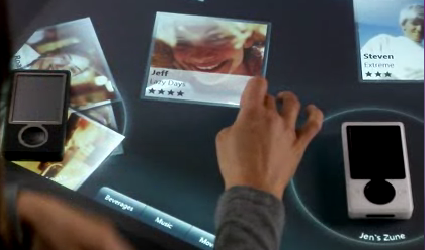
Microsoft Surface is a pretty amazing piece of research: tabletop touchscreen computing done really well. But, the “origins” section on the Surface website strongly implies that the whole concept of tabletop computing originated from Microsoft. It didn’t. If you find this stuff exciting, you should check out some of the prior research in this area.
MERL’s diamond touch : one of the first multi-touch technologies (works by running an electronic signal to your finger via your chair to identify each user).
IPSI’s roomware: this is an entire room decked out as touchscreen surfaces that are all linked together.
Stanford’s Tabletop groupware: they’ve done tons of stuff in the area. You may recognise some of the gestural stuff that also appears in the MS video.
Jun Rekimoto’s work (Sony) this includes “holotable”, “smart skin” and “augmented surfaces”. Jun is a genius- in my opinion, his research is genre defining.
I’m not saying that it’s a bad thing that Microsoft are building on top of prior research – this is, after all, what research is all about. I’m just trying to say that there are some talented people and research groups out there that also deserve recognition for the state of the art today.
A much more thorough review of touch and multi-touch research can be found on Bill Buxton’s website:
http://www.billbuxton.com/multitouchOverview.html
On the one hand their work is great. Probably best in field. On the other, it sucks that they feel they need to pretend that the whole movement started internal to MS. Lamers.
Pingback: Front to back » Blog Archive » iPhone: a whole new chapter in user experience
IdentityMine, one of the top Microsoft Surface shops (the creator of the Winebar and Snowboard applications demonstrated by Bill Gates at CES 2008) has released videos demonstrating PhysicsPanel – a library for creating physics-enabled applications for Surface (as well as anything else .NET 3.0 runs on like XP, Vista and Windows Mobile). It’s an awesome first look under the hood of Surface development.
http://uihero.wordpress.com/2008/09/08/wpf-and-surface-physics-code-video/
Yes, it didn’t invent also the weel. And you can easily compare this to multitouch that iPhone and iPod uses. As ar as I know, there are other implementations with bigger screen sizes and other frameworks that implement this.
Just wait a little, ,maybe Apple will pull out a table like this and you’ll not say that “origins” were Microsoft or other researcher that created the idea but lacked the implementation, but rather an amaizing Apple product that will revolutionize the market.